
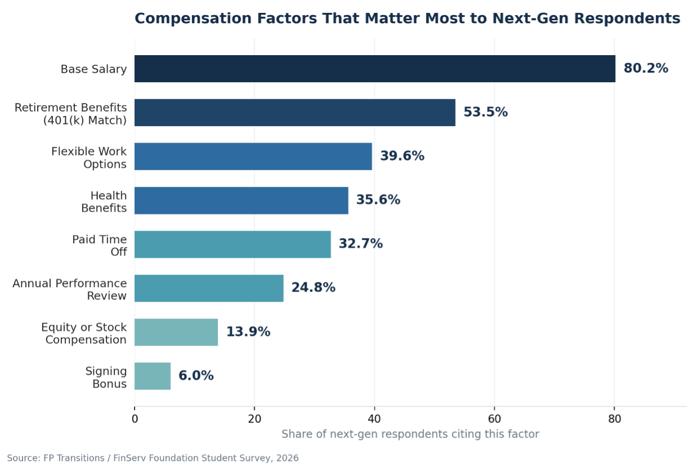
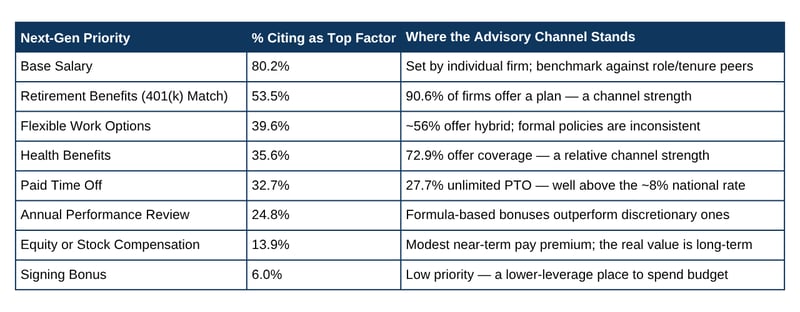
The overarching priority of Next Gen talent is market-rate base compensation. But the next four factors — retirement matching, flexible work, health benefits, and paid time off — cluster together as a distinct second tier, well ahead of the other items that firms often assume matter most to younger candidates (signing bonus, equity pathways).
Benefits vs. Firm Size
WHERE YOUR FIRM LIKELY ALREADY HAS AN EDGE
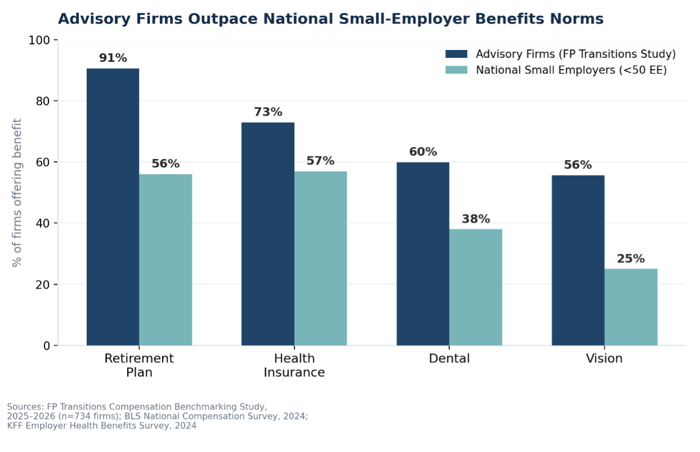
On the factors next-gen candidates rank second and third (retirement and health benefits) the independent advisory channel already outperforms the broader small-business market by a wide margin.
EQUITY AND STOCK COMPENSATION: SET EXPECTATIONS EARLY
Only 13.9% of next-gen respondents cite equity or stock compensation as a top priority. However, for the subset of candidates thinking about a long-term career at your firm rather than a stepping-stone role, this is where the real financial upside sits, and it's worth being transparent about it early.
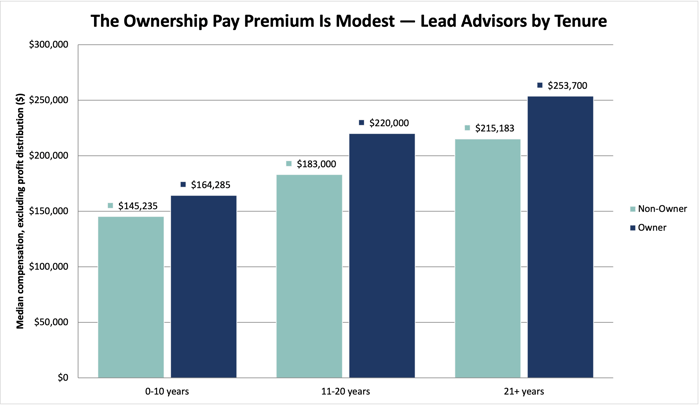
For candidates who are eager to join the equity pool, it's worth being precise with them about what the move to owner or partner is. It's not uncommon for a candidate to think of the move to Partner or Owner as a promotion, often the next step up from a lead advisor role. But the more useful way to think about it, from a compensation standpoint and carer standpoint is as a capital event. When equity is placed on the table, the advisor is typically buying the equity from one of the existing partners, not simply taking on a new title with a higher salary attached. Our benchmarking data reflects that distinction. Among lead advisors with comparable role and tenure, owners earn only 13–20% more in base pay than non-owners doing similar work.³ The real financial difference is created by profit distributions received as an equity owner of the business — a return on the capital the owner has invested, not additional pay for the work itself. That distribution reaches a median of roughly $246,500 annually for owners at 21-plus years of tenure, on top of comparable base compensation.
A candidate motivated primarily by immediate pay won't find much difference between an owner-track and non-owner role in the first several years. A candidate motivated by building equity in a business they'll eventually help run is looking at a fundamentally different opportunity, but one whose value comes from ownership itself, not from a raise, and one that pays off on a longer horizon. Being explicit about that distinction, rather than treating “path to partnership” as a vague future promise, is itself a differentiator: our student survey found that entrepreneurial opportunity and long-term earning potential were cited by 68.3% and 58.4% of respondents, respectively, as reasons they're drawn to this career in the first place.⁴
A related point worth raising directly with candidates who ask about long-term career paths: having an identified next-generation owner in mind is common industry-wide, but it's a meaningfully lower bar than having a funded, intentional succession plan or an equity-based compensation structure for your existing staff. If your business has a defined succession plan or path to equity compensation, that's worth saying explicitly – most firms speak around this is vague generalities, not with a defined plan.
ANNUAL PERFORMANCE REVIEW:
THE BONUS STRUCTURE BEHIND IT
24.8% of next-gen respondents cite the annual performance review as a top compensation factor — a proxy, in most firms, for how (and whether) performance translates into an increase in base compensation or a bonus. Our data offers a useful data point here.
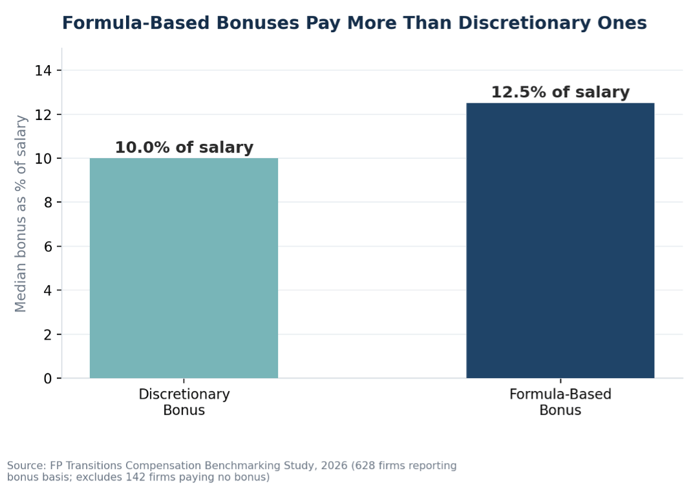
Among firms that pay a bonus, more than half report basing it at least partly on discretion, and one in five rely on discretion alone.⁵ But formula-based bonuses actually pay out more: a median 12.5% of salary, compared to 10.0% for discretionary bonuses — and the gap isn't explained by discretionary bonuses simply going to fewer, bigger outliers; formula-based bonuses run larger on the whole, not just at the top.
For a candidate who says a visible link between performance and pay matters to them, a formula-based structure is a concrete, low-cost thing to point to and is more persuasive than a vague statement about how your business “rewards top performers.” A formal bonus structure also be a signal to candidates that there is opportunity to develop their skills in a very practical way within your organization and be recognized for it.
QUICK-REFERENCE: PRIORITIES VS. CURRENT OFFERING
Putting This to Work
If you're weighing where to invest the time and money to attract top talent, this data suggests a reasonable order of operations: 1) review the base compensation package you’re offering for open roles and determine if it’s industry-competitive, 2) lead with retirement and health benefits, since both are high-priority for candidates; 3) formalize a flexible work policy, since it's a top-three priority that many firms already deliver informally but don't document; 4) be explicit and specific about performance-based pay and any potential path to partnership (to the extent there is one), rather than describing either in vague terms.
The data in this article comes from FP Transitions' own compensation and benefits benchmarking data, refreshed on a rolling basis as new firms complete the survey, which is what makes a resource like this possible in the first place.